Welcome to the third annual Illinois Fiber Festival! We hope to see you Saturday March 7th 2026 at the McLean County Fairgrounds in Bloomington, Illinois from 9am-4pm (vendors, class times may vary). There will be over two dozen vendors showcasing the best of the best of fibers. They’ll be something there for everyone including yarn, roving, fiber batts, rug yarn, finished goods, yarn bowls, and CLASSES. Our offered course schedule is impressive but limited. Please register ASAP to ensure your spot. Please see below for course descriptions and to register. PLEASE NOTE CLASS TIMES DO NOT REFLECT FESTIVAL TIMES FOR ALL COURSES.
Linen’s Journey - What’s Old is New Again
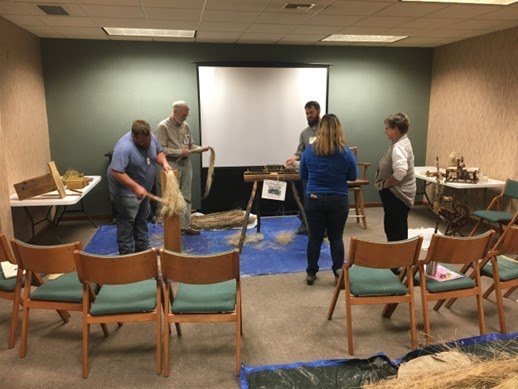
GOAL - The oldest known human spun fiber is Flax. This presentation will explore the history of the “most useful plant” - Linum usitissimum. We will explore the history of flax; the planting, cultivation, and harvesting of the plant; its morphology; the steps and tools of extracting the fibers; how it is spun into yarn; and discuss its utilities and impacts on the environment.
COST- $40
TIME- 9am-11am
CLASS INSTRUCTOR- Tom and Joanne began raising flax, demonstrating fiber extraction, and lecturing on the history, anatomy, and uses of flax ad linen since the early 1980s. Tom has a BS in Interpretive work and 2 master's degrees in education; Joanne has a BA in Clothing and Textiles.

“Breaking, Scutching, Hackling” … OH, my. Processing Flax into Linen
GOAL- This workshop will inform participants about processing the harvested flax plant to extract the fibers for spinning and other uses. Participants will ripple and break the plant, then scutch and hackle the fiber producing a strict of fiber flax while using traditional tools. Time permitting, instruction on spinning, and using a drop spindle to produce linen yarn, will be available.
COST- $40
TIME- 1PM-3PM
CLASS INSTRUCTOR- Tom and Joanne have been raising, processing, and teaching and demonstrating flax fiber extraction, spinning and weaving for 40+ years. Tom has a B.Sci. degree in Natural Resources - Interpretation, and two master's degrees in secondary education; Joanne has a B.A. in Clothing and Textiles.
PLEASE BRING- Outerwear for working outside.
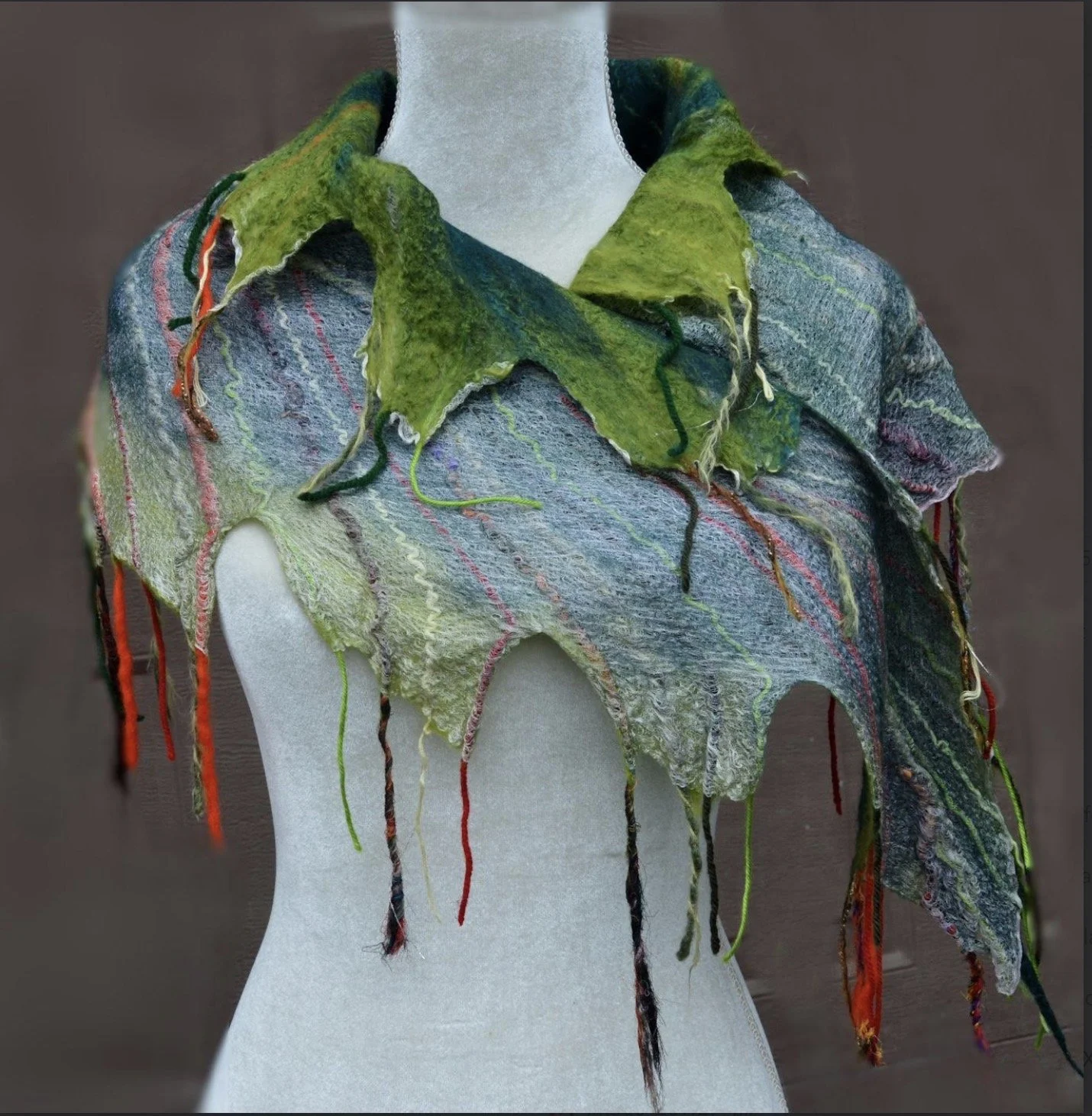
Nuno Felted Double Sided Scarf-Leaf
In this hands on workshop, students will learn how to create a beautiful double-sided scarf using the nuno felting technique. This class is perfect for beginners and introduces the art of wet felting with a focus on working with extra fine merino wool roving, silk fabric, viscose fiber and decorative yarns. You will learn:
The Basics of Wet Felting: understand how hot water and soap, combined with agitation and compression, transform loose wool fibers into felt- the oldest known textile.
Introduction to Nuno Felting: explore how wool fibers bond with sheer fabrics like silk gauze to create a lightweight, textured material. The term “nuno” means “cloth” in Japanese.
Fiber and Fabric Fusion: Learn how to layer and felt different materials together for texture, strength, and visual interest.
COST- $110
TIME- 10am-4pm (including a lunch break).
CLASS INSTRUCTOR- My name is Mariya Gerhardt. I am a fiber artist – felt maker and knitter. When I discovered wet felting I was hooked by its magic when a fabric, a living image, is born from a bunch of scattered fibers of wool, silk and other fibers. I have doing wet felting over 6 years and still a lot of experimenting and discovery for me. I like to work with natural fiber, raw fleeces, use a lot of recycled material like - silk, cotton and viscose fabric and fiber. I have been obsessed with exploring the possibilities of felting and would love to share the joy of creating with others. I am teaching the wet felting and nuno felting classes on the various fiber show.
PLEASE BRING- Scissors and an old towel.
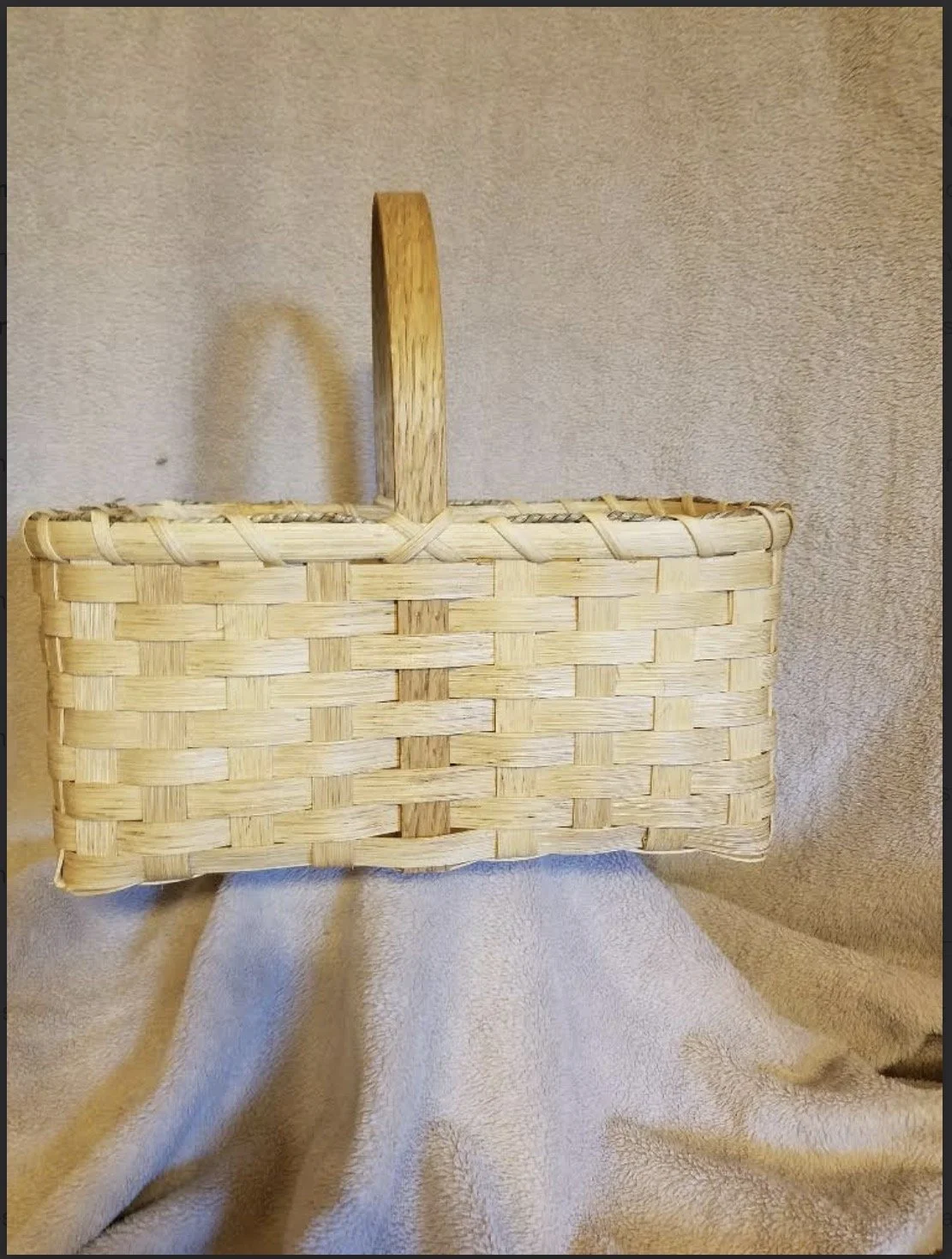
Making a Market Basket
GOAL- 12 x 8 x 8, more or less. The question is…. what can’t you use a market basket for? It’s great for going to the farmers market, or the garden, or to set by the door for all the items that go out to the car. Or how about having one for each child and it collects all their misplaced toys to be taken to their room?
In this class you will learn, how to identify the “right” or “wrong” side of the reed, how to twine, start/stop weaving, applying the rim and lashing it all into place. This is the perfect basket for beginners as well as experienced weavers.
COST- $65
TIME- 1pm-4pm
CLASS INSTRUCTOR- Laura has been weaving baskets for over 30 years and teaching for more than 20. She regularly teaches at Missouri State Historic Sites as well as the local Community College, in addition to several Fiber Festivals throughout the Midwest. She loves to share the joy of basket weaving with those around her and teaches all age ranges from children to folks in a retirement community.
NO SUPPLIES NEEDED
Learning to Warp and Weave on a RHL
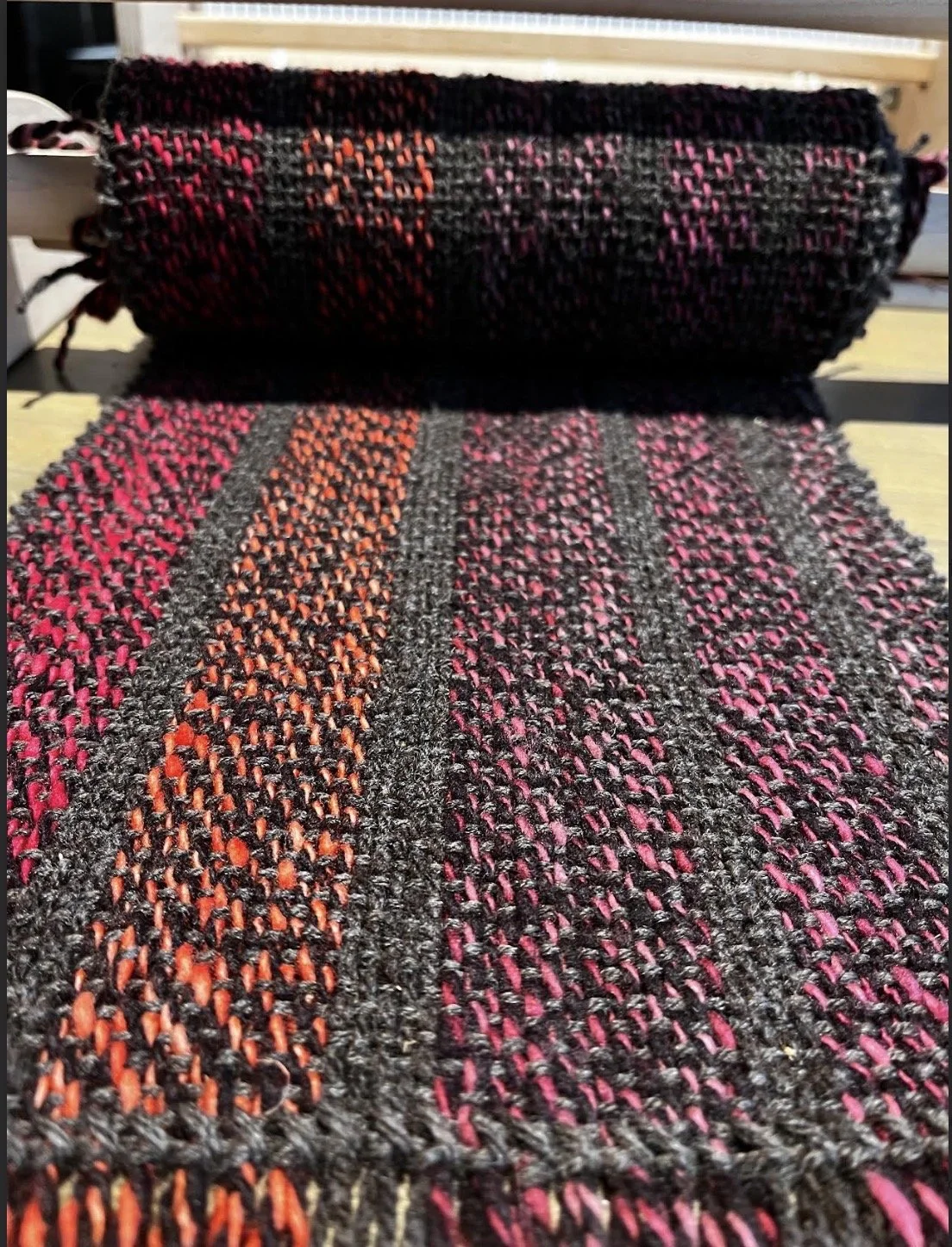
GOAL- Does the warping process of a floor loom overwhelm you? Is your stash of homespun yarn or other beautiful yarn taking over your home? That used to be me until I learned the ease of warping a rigid heddle loom.
Join me to learn the basics of weaving on a rigid heddle loom. Talk like a weaver, direct warp a rigid heddle loom like a pro, and create something beautiful. We will work through the direct warping steps and create a mug rug or short placemat. I will provide rigid heddle looms (10” or 15” Schacht Cricket or Ashford knitter's loom) so you can try before you buy your own. These portable looms allow you to create on the go! This class will move at a fast rate because I’d like to keep it to half a day. If you don’t finish your project in the 4-hour class time, you can work on the project throughout the day.*
The instructor will provide: our Illinois grown wool yarn, the loom and all warping tools, and warping & weaving directions. (If you have your own RHL, you can use yours!)
COST- $110
TIME- 9am-1pm
CLASS INSTRUCTOR- Anne Sammons of Leaf Livestock Wool Co is a teacher, spinner, weaver, shepherd, rhl pattern designer, and now an author. Her family raises Polypays, Merinos, and Natural Colored Rambouillet x Columbia and Targhee crosses in NW Illinois. Their wool is processed in Midwest mills and enjoyed by creators all over the US!
PLEASE BRING- A pencil for notes, scissors, a container for the yarn.
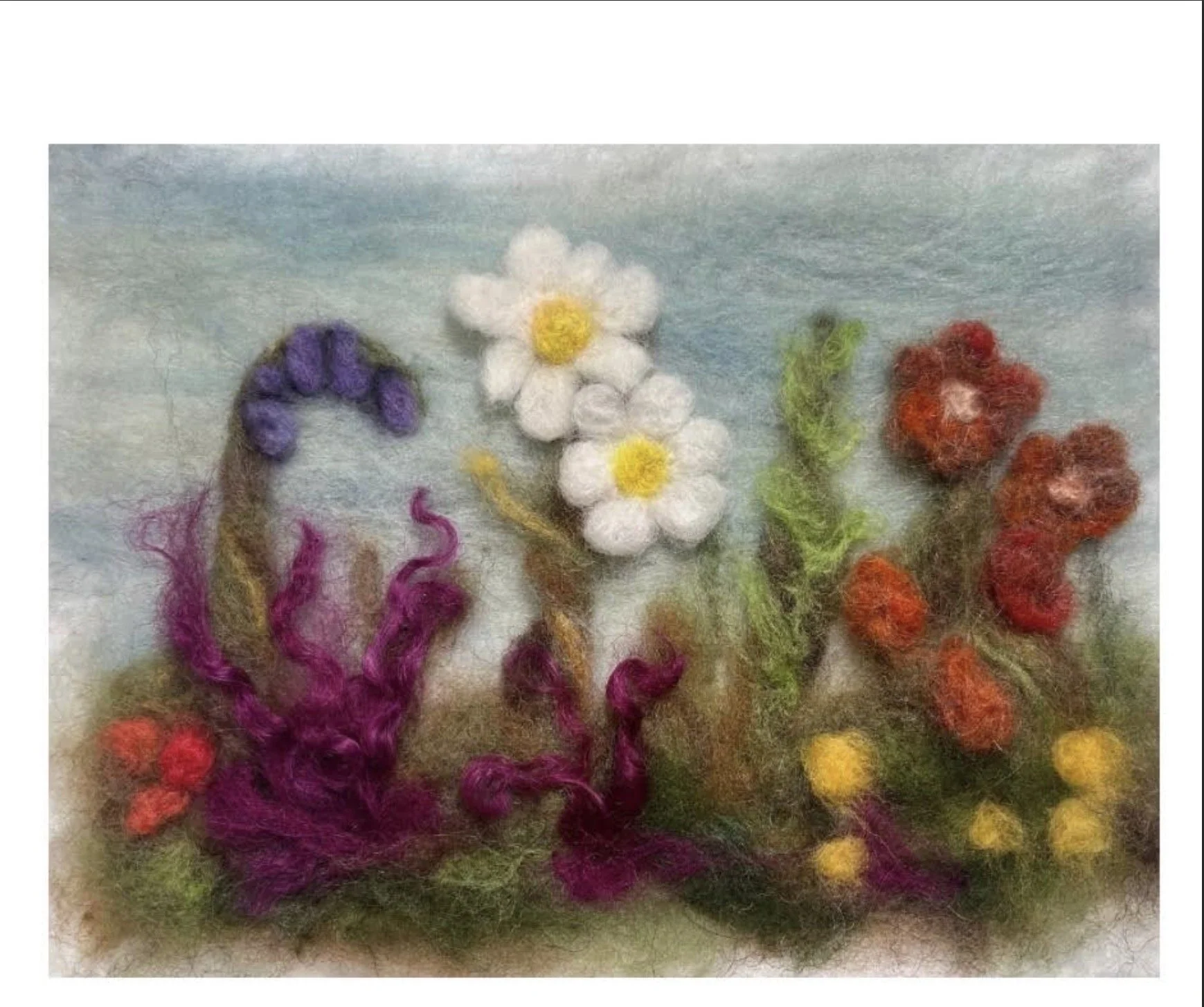
You Can Create a Beautiful Needle Felted Flower Meadow
.GOAL- You will learn the basic art of needle felting, and all the techniques to make a beautiful 9 x 12 flower meadow. All of the tools you will need will be provided for you to use. There will be a large variety of wool provided in many different colors to choose from.
COST- $75
TIME- 12pm-4pm
CLASS INSTRUCTOR- I have been an “budding” artist since high school, and especially love any type of sculpture. Medias I have used include glass, clay, paint, ink. I fell in love with needle felting about a year ago, and made a quest of finding out all about different techniques, wools, needles, and tools. I have made many 2-D and 3-D sculptures, and recently won 1st place in an art exhibit with a 16 x 16 2/3D (base relief) of a mama tiger and cub. I also teach classes at the Geneseo Art League. My love for this art form will be evident in my class.
NO SUPPLIES NEEDED
Learning to Twine
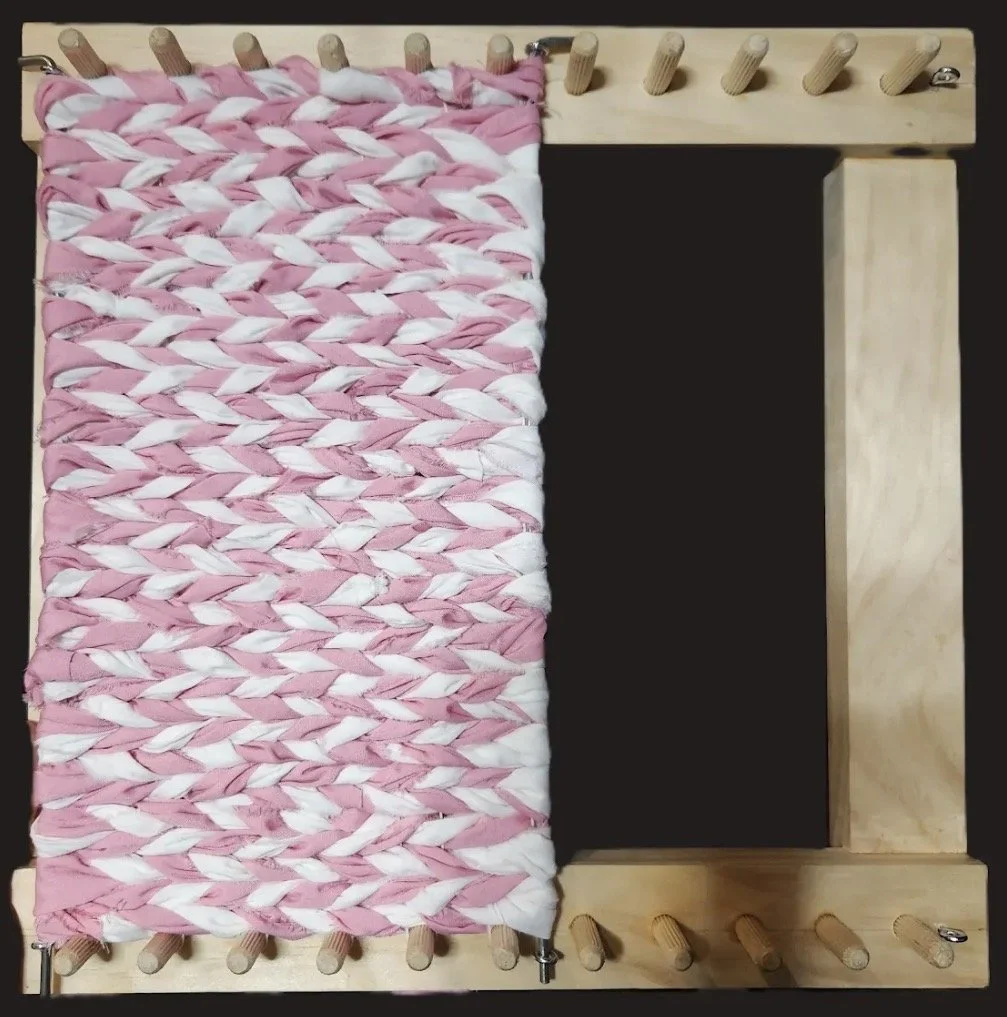
GOAL- Twining is an ancient technique, used in basket-making and weaving worldwide. Over a century ago, twining began to be used to weave rugs. Twined rugs are made on upright frames and resemble braided rugs. Making rugs from rags became popular during the 19th century with the industrial production of cloth. It was a popular household craft in America until the beginning of World War I.
Who is this class for? EVERYONE! We will start with the basics and teach you what you need to know to make a twined rag potholder or trivet.
In this class, we will jump into the weaving world with fabric. This loom is a great way to try something new. We will use 2 precut fabric pieces. The colors work best if they contrast with each other. It takes a bit to get the hang of it, but by the end of class, you will either be finished with your potholder/trivet or very close to finished. You will be able to leave class ready to start a twined rug!
No Materials Fee: Fabric and Warp are included in your class fee. Scissors and other tools are supplied.
COST- Class with borrowed loom $55, class with pre-purchased loom $75
TIME- 9am-12pm
CLASS INSTRUCTOR- Laurie Taylor has been immersed in the world of fiber arts for more than three decades. An avid spinner for over 20 years, she especially enjoys working with heritage breeds such as Shetland, Jacob, and Romney. Laurie’s fiber journey began in childhood with crochet, later blossoming into knitting when she taught herself the Continental method after many years of trying to master her mother’s English style.
In addition to spinning, knitting, and crocheting, Laurie is an experienced hand sewer and weaver, currently exploring the craft on a Harrisville Designs 4T/4H loom. She has also been twining for nearly seven years, jumping in with both feet by making rugs.
Laurie believes that fiber arts are a communal practice as much as a creative one. She sees every fiber artist as a teacher at heart, always ready to lend a hand, offer advice, or share in the joy when someone asks, “Can you look at this?” Her classes reflect that spirit of generosity, blending technical skill with encouragement, curiosity, and a deep respect for traditional crafts.
NO MATERIALS NEEDED
Wonderful Wild Silks
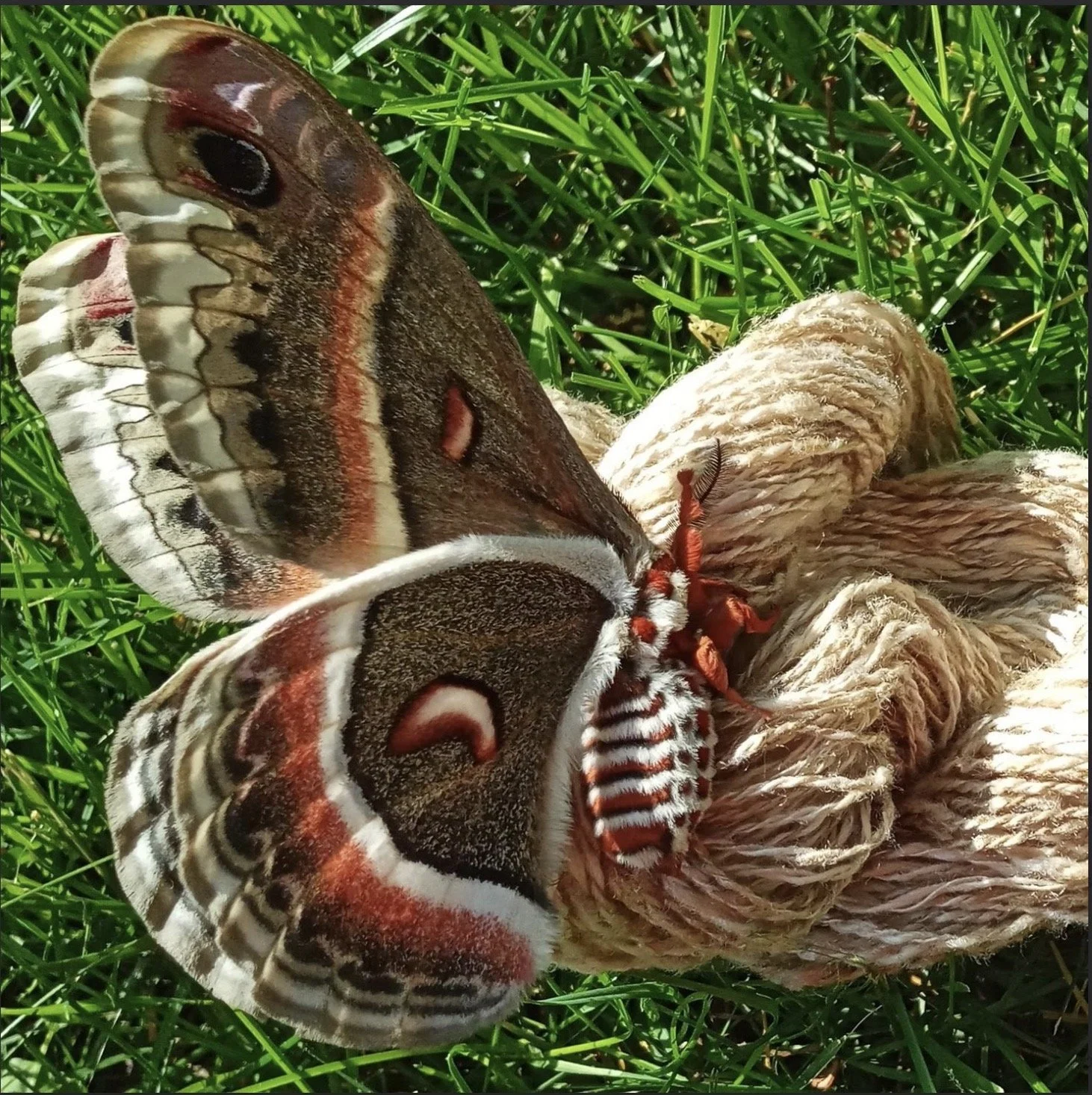
GOAL- Many moths produce silk besides Bombyx mori (mulberry silk). Explore the wonderful world of wild and semi-wild silks. Sample Cecropia, Polyphemus, Promethea, Luna, Calleta, and more from North America; Ceranchia and others from Madagascar; Cricula from Indonesia; semi-wild Eri, Muga, and Tropical Tussah from India; and Chinese Oak Tussah from China. Learn about the species of moths that produce each of these silks and many other species that have been used historically on almost every continent. Some cocoons will be degummed (softened) and there will be samples to spin. Some species are not usually spun; learn how these can be incorporated into fiber art.
COST- $70
TIME- 1pm-4pm
CLASS INSTRUCTOR- Esther Peregrine began raising silkworms in 2006 and fell in love with the whole progression of watching the silkworms grow and make their cocoons, processing the cocoons into yarn or thread and ultimately weaving or knitting a finished silk scarf or shirt. She had the opportunity to participate in a Silk Study Tour to Japan in 2023 to learn about silk in Japan. In addition to domesticated silkworms, Esther raises native Cecropia and Polyphemus wild silkmoths and spins silk yarn from their cocoons. She also works with semi-wild silks such as Eri, Tussah, and Muga. Esther and her silk have come to schools, museums, and fiber festivals.
PLEASE BRING- Spinning wheel or drop spindle, hand carders, scissors.